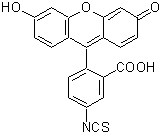
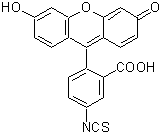
Intended use For in vitro diagnostic use. F 0169 is intended for the demonstration of complement C4, C4b and C4c in tissue sections, and may also be used for other immunofluorescence techniques. Interpretation of results must be made within the context of the patient’s clinical history and other diagnostic tests by a certified professional.
丹科DAKO兔抗人IgA/FITC标记二抗,Polyclonal Rabbit Anti-Human IgA
货号:F020402-2
规格:2ml
现货供应中
丹科DAKO兔抗人IgA/FITC标记二抗,Polyclonal Rabbit Anti-Human IgA
简介:
Polyclonal Rabbit Anti-Human
IgA, Specific for Alpha-Chains
For use in methods demanding a very high specificity. The specificity and performance of the antibody have been ascertained in immunohistochemistry and ELISA. Additionally, the specificity has been tested by crossed immunoelectrophoresis using 12.5 microlitre antibody per square cm gel area against 2 microlitre human plasma. The antigen used for immunization is serum IgA.
The F(ab')2 fragment antibody is particularly useful for labeling unfixed blood cells containing active Fc receptors, and for other applications where the Fc part of the antibody molecule could disturb.
Please note that F(ab')2 fragment antibodies are not suited for techniques dependant on aggregation or precipitation of antigen-antibody complexes.
DAKO(丹科)兔抗人IgM/FITC标记,Rb a Hu IgM/FITC英文民:Rb a Hu IgM/FITC规格:2ml货号:F020302-2现货供应
详细介绍
DAKO(丹科)兔抗人IgM/FITC标记,Rb a Hu IgM/FITC
英文名:Polyclonal Rabbit Anti-Human IgM/FITC
规格:2ml
DAKO(丹科)兔抗人IgM/FITC标记,Rb a Hu IgM/FITC
For use in methods demanding a very high specificity. The specificity and performance of the antibody have been ascertained in immunohistochemistry and ELISA. Additionally, the specificity has been tested by crossed immunoelectrophoresis using 12.5 microlitre antibody per square cm gel area against 2 microlitre human plasma.
The F(ab')2 fragment antibody is particularly useful for labeling unfixed blood cells containing active Fc receptors, and for other applications where the Fc part of the antibody molecule could disturb.
Please note that F(ab')2 fragment antibodies are not suited for techniques dependant on aggregation or precipitation of antigen-antibody complexes.
Casciola-Rosen L, Rosen A, Petri M, Schlissel M. Surface blebs on apoptotic cells are sites of enhanced procoagulant activity: implications for coagulation events
and antigenic spread in systemic lupus erythematosus. Proc Natl Acad Sci U S A. 1996; 93(4):1624-1629. (Biology)
Homburg CH, de Haas M, von dem Borne AE, Verhoeven AJ, Reuingsperger CP, Roos D. Human neutrophils lose their surface Fc gamma RIII and acquire
Annexin V binding sites during apoptosis in vitro. Blood. 1995; 85(2):532-540. (Biology)
Koopman G, Reuingsperger CP, Kuijten GA, Keehnen RM, Pals ST, van Oers MH. Annexin V for flow cytometric detection of phosphatidylserine expression on
B cells undergoing apoptosis. Blood. 1994; 84(5):1415-1420. (Biology)
Martin SJ, Reuingsperger CP, McGahon AJ, et al. Early redistribution of plasma membrane phosphatidylserine is a general feature of apoptosis regardless of
the initiating stimulus: inhibition by overexpression of Bcl-2 and Abl. J Exp Med. 1995; 182(5):1545-1556. (Biology)
O’Brien MC, Bolton WE. Comparison of cell viability probes compatible with fixation and permeabilization for combined surface and intracellular staining in flow
Raynal P, Pollard HB. Annexins: the problem of assessing the biological role for a gene family of multifunctional calcium- and phospholipid-binding proteins.
Schmid I, Krall WJ, Uittenbogaart CH, Braun J, Giorgi JV. Dead cell discrimination with 7-amino-actinomycin D in combination with dual color immunofluorescence
in single laser flow cytometry. Cytometry. 1992; 13(2):204-208. (Biology)
van Engeland M, Ramaekers FC, Schutte B, Reuingsperger CP. A novel assay to measure loss of plasma membrane asymmetry during apoptosis of adherent
cells in culture. Cytometry. 1996; 24(2):131-139. (Biology)
Vermes I, Haanen C, Steffens-Nakken H, Reuingsperger C. A novel assay for apoptosis. Flow cytometric detection of phosphatidylserine expression on early
apoptotic cells using fluorescein labelled Annexin V. J Immunol Methods. 1995; 184(1):39-51. (Biology)
1) 川村明義, "蛍光抗体法(fluorescent antibody technique), 免疫の生化学", 共立出版, 1996. 2) H. Kawaguchi, K. Tuzimura, H. Maeda and N. Ishida, "Reaction of Fluorescein-isothiocyanate with Proteins and Amino Acids", J. Biochem., 1969, 66, 783. 3) H. Maeda, N. Ishida, H. Kawauchi and K. Tuzimura, "Reaction of Fluorescein-Isothiocyanate with Proteins and Amino Acids", J. Biochem., 1969, 65, 777. 4) W. B. Cherry, "Evaluation of Commercial Fluorescein Isothiocyanates Used in Fluorescent Antibody Studies", Stain Technology, 1969, 44, 179. 5) 川村明義, 和田計二, 浜島健治, 村田道里, "蛍光抗体法における観察法とその進歩",臨床検査, 1973, 17, 28. 6) 村本光二, 目黒煕, "けい光によるペプチドの構造解析の超微量化の試み", ぶんせき, 1979, 821. 7) G. Radcliff, R. Waite, J. Lefevre, M. D. Poulik and D. M. Callewaert, "Quantification of Effector/Target Conjugation Involving Natural Killer(NK) or Lymphokine Activated Killer(LAK) Cells by Two-color Flow Cytometry", J. Immunol. Methods, 1991, 139, 281. 8) C. Souchier, M. Ffrench, M. Benchaib, R. Catallo and P. A. Bryon, "Methods for Cell Proloferation Analysis by Fluorescent Image Cytometry", Cytometry, 1995, 20, 203.
よくある質問
Q
FITC-I を使用したタンパク質標識の方法を教えてください。
A
FITC-I による標識例を紹介致します。 この方法は次の書籍を参考としております。 ・G. T. Hermanson, "Bioconjugate Techniques, Second Edition", Elsevier, 2008.


 FITC-I